Sunday, 1 January 2012

In Tengu Territory

Tengu - one of the most famous 'species' of Japanese supernatural beings - are everywhere in Japan. But, what they actually ARE is surprisingly unclear. How do you spot a Tengu?

Most of the Tengu statues I'd seen were in front of Buddhist shrines. So, to begin with, logically (to me at least) I assumed that a Tengu was some kind of benevolent guardian spirit, protecting a sacred place from harm. The one in the middle of this very useful-looking trio outside a shrine on Mt Takao, looks especially fierce...


...but the one on the left with the hawk's beak and wings looks the least human, which, I guessed, meant it was supposed to be the most powerful


But the one on the right was more difficult. It didn't look that impressive. In fact, the only difference between the Tengu and a regular old man with a big nose was its wings...which were almost completely hidden behind it


But, it was the old man Tengu on the right that really got me thinking. What protector-demon would choose to present itself as a fat retired warrior? What being has not one, not two, but three different versions of itself standing outside a Buddhist temple?

A quick search later, I was more confused and none the wiser. Tengu can be almost anything. Sometimes they are scary goblins / ghosts...


...and sometimes, god-like swordfighting teachers


...but quite often they also appear as bird-featured Yokai shapeshifters


Animal shapes have nothing to do with a Tengu's power rating, either (if anything bird-Tengu are less powerful than the more human-looking ones) so my first assumption was resoundingly wrong. Classifying these beings was going to be more of a challenge than I'd signed up for. But, ever-curious, I forged ahead anyway.

So, Tengu appear in lots of different roles: fine. But, do the different Tengu have any common characteristics - anything that might help justify the fact that they are all called by the same name?

I needed help.

Luckily, I didn't have to look far: the first answer was in Dai-e, the very next Noh play I read. The main character was a Tengu from Mt Hiei. All the other Tengu I'd come across also live on mountains, protecting a Buddhist shrine. So the first thing I learnt was

Tengu live in - perhaps are tied to - particular mountains

So far, so good. But the Dai-e Tengu seems more mountain-dwelling dress-up artist than protector. First, it appears in disguise, as a wise priest, hiding its Tengu features behind a human 'mask' (unusually for a Noh main character, the actor appears unmasked). The Tengu meets a traveller who had once saved its life, and as a thank you gesture the Tengu promises to grant the traveller a wish. The traveller wants nothing more than to see and worship the great Buddhist sage Sakyamuni. Unsurprisingly, the Tengu doesn't know the great Sage well enough to ask him over, so it decides to fake it. The next time the Tengu appears, it is as Sakyamuni, wearing a huge mask, with lots of small Tengu posing as 'disciples'.


At no point in the play does the Tengu appear in a recognisably Tengu-like representation - something like this

or, this


Lesson 2 was reasonably clear:

Tengu like dressing up as other people

Now I felt like I was at least getting somewhere. So, Tengu seem to be good at changing shape. Unfortunately for them though, their acting skills are rather less impressive than their costume choices. At the end of Dai-e, and in other plays, the Tengu's scheme is discovered by an angry deity who chases the Tengu off into the mountains. Ooops!

Then, from the folk tale Tengu no Hyotan (where a Tengu tries to play a nasty prank on a Gambler, but actually ends up making him a very rich and happy man) I also discovered that Tengu like to play jokes on people and try to outwit them. But it never quite works out that way: either the baddie gets his just desserts by accident, or the Tengu makes a fatal mistake, allowing the baddie to outwit it. Oh dear.

So, I thought it would be safe to say that I had learnt my third lesson:

Tengu are not very good Tricksters

Armed with these three lessons, I thought I'd got a pretty good idea of what Tengu were: powerful, mountain-dwelling figures of fun. Mostly. But where does the 'wise teacher / expert swordfighter' role come in? In the famous Noh play Kurama Tengu, the main character (dressed up as a priest less noble than itself) trains a young boy who later becomes Japan's most famous General, in the arts of war...

Arrgh!

At this point, I decided to quit while I still could.

In the world of Japanese monsters, Tengu are clearly more of a continent than a species. But at least I know enough about them now to recognise one. Possibly. Provided it hasn't made an extra special effort with that day's disguise...

Friday, 23 December 2011

Rakugo Heaven

I was excited about a lot of things, coming to Japan, but finding out more about Rakugo - traditional Japanese storytelling - was probably top of the list.


I saw my first Tokyo Rakugo - the famous Japanese ghost story Banchou Sarashiki - by lantern light in the middle of Aoyama Cemetery. Okiku, a beautiful servant girl, is in charge of a samurai family's priceless collection of ten plates. But, in revenge for her refusal of his advances, the evil Son hides one of the plates, knowing that its loss will mean Okiku's death. Sadistically, he makes her count them one by one...the tenth is of course nowhere to be found. She counts again. And again. And again. Even after her death, you can still hear Okiku's ghost constantly counting up to nine, never finding the tenth plate.

The way Rakugo tellers bring old stories to life seems like magic to me. No costume changes, hardly any movement, just two props (always a fan and a hanky) but maximum effect. A slight downward glance and a sigh, and the teller became Okiku; a moment later, shifting her eyes front and squaring her shoulders, she became the Father. I was completely transfixed. I had to see more Rakugo.

Lucky for me, I immediately found that the brilliant Diane Orrett, who trained in Japan as a Rakugo teller, was on for one night only in Asakusa, telling stories in Japanese and English.


So, armed with another three brilliant stories and some notes about how Rakugo works, I set out to find even more. I started with the Japanese TV series Tiger and Dragon, which apparently re-popularised classical Rakugo for young Japanese audiences. The performance of Neko no Sara (the cat's plate) was hilarious even without the subtitles


Now I realise I've barely even begun: Sue Hiro Tei, one of the last Yose (400-year old theatres especially built for storytelling) in Japan, is my next target.


It's hugely famous. It shows Rakugo all day, almost every day of the year. And, best of all, its a 10 minute train ride from where I live. There are no subtitles...but with stories this funny, who really needs them?

What am I waiting for!

Tuesday, 6 December 2011

Shrines at Night

Friday night was 'Octopus night' in Shinjuku. At Hanazono Shrine, before my eyes, these


got turned into this - the most tentacle-tastic Takoyaki (octopus pancakes) I've eaten in Tokyo. Yum!


This octopus feast was courtesy of one of Tokyo's liveliest night-time festivals, Tori no Ichi. It's a celebration of good fortune held in Japan on Chinese 'Rooster' days during November. It was late, but people were everywhere - eating, drinking and praying to the gods for riches:


Between the main Torii gate and the shrine itself, stalls were selling everything from lucky rakes to the sight of a woman eating a live snake (!)


Shrines aren't always full of people, though. And when they aren't, they are spooky. The sight of this Torii on a dark walk home on another night was decidedly unsettling:


It got me thinking about Japanese ghosts - Yurei. In the stories, these phantoms can appear anywhere, but most often in the Japanese 'witching hour' between 2 and 3 in the morning.

Which is about when I walked past this. Eep!

Saturday, 3 December 2011

Momiji Madness!

Autumn is supposed to be the most beautiful season of the year in Japan. The leaves on all the Momiji (red maple) trees turn red, the sky is by turns deep blue and a bright grey that makes colours stand out like children's lollipops in photos, and thousands of people flock to parks and mountains and woods to admire the scenery. Viewing the autumn leaves has a word all its own: Momijigari.

Photo by Crystal Japan

This year, though, Autumn came so late to Tokyo that there were hardly any red leaves in sight at Mount Takao's famous all November-long Momiji Matsuri (Maple Leaf Festival) until its very final week - and there still weren't many even then, when I finally made the trip there.

But I was delighted anyway. Tokyo has everything but open space; I hadn't really seen anywhere that wasn't full of buildings and people since I went to Hanno in September. So the forest on the mountainside alone was like paradise to me...


...but I had to admit that the leaves that had turned were utterly spectacular


 ...and thanks to the chair lifts (the mountain is so small it really doesn't need them, but I wasn't complaining) our Momijigari was the easiest thing in the world.


Luxury!


The maple leaves weren't the only red foliage to see on Mount Takao. These cute bushes looked like they'd been spray-painted...


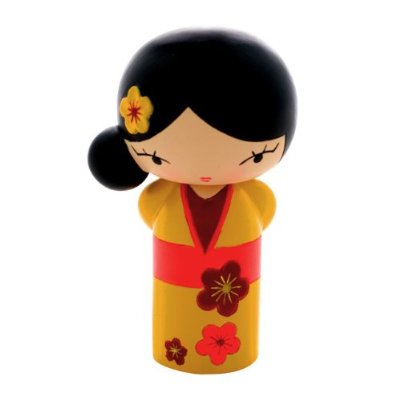
...which reminded me of those super-cute good-luck dolls, also called Momiji. Sadly the word similarity is just a co-incidence, but this one is dressed very appropriately anyway - in a demure autumn-coloured kimono:


All kinds of art in Japan IS inspired by the autumn Momiji though, including Noh. One of the most famous Noh plays ever written is actually called Momijigari. It starts innocuously enough: on a woodland hunt the great soldier Taira no Karemochi bumps into a noblewoman and her party who are, like everyone else in Japan at this time of year, in the mountain woods to view the turning leaves. Or at least, that is what they tell him...


The woman is beautiful, important and flirtatious: Karemochi can't resist talking to her. But as in so many old stories, the Forest is a place where nothing is ever what it seems. Things start getting stranger very quickly. Karemochi is blissfully unaware, even as he is being lulled into an enchanted sleep by beautiful dancing and far too much sake...


 ..that the beautiful lady is actually a demon in disguise. Later, the demon returns in its true form to create who knows what kind of mischief, and Karemochi shows no sign of noticing the danger. So, an Old Man - really Takeuchi, a retainer of the great Boddhisattva Hachiman, in disguise - has to save the day by appearing to Karemochi in a dream, leaving an enchanted sword by his side, and talking him into waking up. When he does, he finds the demon right infront of him


getting closer all the time


With his enchanted sword, Karemochi fights the demon... 


a spectacular fight, the most dynamic I've seen so far in Noh - made all the more spectacular coming straight after a long period of almost total stillness on stage.

Back in Tokyo, in the real world, now, with only 20 days to go until Christmas, the real-life Momiji leaves have really only just started falling. The weather is as unpredictable as the Forest here: winter might appear for a few hours (the temperature plummets and people start wearing woolly hats) but then it quickly hides again behind autumn sun and warm rain. Crazy!

Sunday, 27 November 2011

Tokyo Book Universe

When I first arrived in Tokyo, I was drawn like a charged magnet to Tokyo's book district, Jimbocho, before I even really knew where I was. It was very comforting to find it by accident even though I was looking for something else entirely - the best possible homesickness cure.

Book nerd that I am, Jimbocho might be the nearest I'm ever going to get to 'heaven'.  It has the largest concentration of bookshops - both new books and secondhand ones - in the whole of Japan...


It also has its very own weekend-long festival, dedicated to furui hon (old books). Lanterns light up the streets and there are book stalls everywhere, right outside the book shops. My snapshot from the festival doesn't do it justice at all -


Now, I don't have to go back there by accident: I actually work there!

But it isn't only Jimbocho that makes Tokyo's book universe so exciting, its the shops and the libraries, too. At one of the shrines in Kamakura last month, I found one of the most beautiful mini libraries I've ever seen.

On the outside, it was guarded by carved gremlin-dragons


and a succession of scary-looking metal statues of samurai stamping on goblins


but inside, amid some eye-bogglingly fantastic ceiling woodwork, was an ingenious book 'merry-go-round'.

When the windows were open, priceless sacred texts were on display
 
And when they were shut, it was all the easier to appreciate the fact that the plainer bookshelves around the outside were made of gleaming Japanese cedar (which smells almost as beautiful as it looks), every inch of them filled with MORE books. I had been taken to Kamakura by a non book-loving friend - politeness was only thing that stopped me from staying at this library all day.

At the Edo Tokyo Museum a couple of weeks later, I happened upon a reconstruction of a Tokyo bookshop from the 19th century.


At least the sign said it was a bookshop - there were so many drawings in the window, I would have mistaken it for an art shop.


Then I read the museum notes, which confirmed what it's not difficult to just 'get' from the amazing variety of word/picture creations I've seen in Japan...that, unlike so many other places, illustration simply never stopped being one of the most important parts of mainstream fiction. Childrens books (Akahon) and 'adult' books (19th century Japanese porn) even had colour coded covers - red or black for children's, yellow for something a little more 'colourful'...

Inside the covers of allmost every genre, almost all genres were - and often still are - heavily illustrated. The museum listed a cross-section: Sharebon (witty novelettes), Kokkeibon (humourous books), Dangibon (sermon-style satirical books), Ninjoobon (romances), Yomihon (history and morality books) - some obvious, some I would never have guessed!

So, armed with this new information, I went back to Jimbocho, to the oldest bookshop I could find, and spent a few hours poring over old (illustrated) scrolls and picture books


Then, I went into one of the offices there, and started working on new books, too.

I love Tokyo!

Sunday, 6 November 2011

Ueno, Samurai, Cuddly Toys

I was delighted when I heard that this Thursday was Bunka no Hi, a national holiday especially dedicated to Japanese Culture. Samurai, rakugo storytelling, kimono: heaven! Meiji Jingu Shrine, where I saw my first fire-lit outdoor (Takigi) Noh play last month, is THE place to go to see traditional culture. So on Thursday afternoon, at the Meiji Jingu Autumn Festival, I saw some brilliant samurai swordplay


sometimes in full armour


Yabusame (samurai archery from the back of a galloping horse)


and, to top it all off, a daylight view of the marvellous Meiji Jingu Shrine itself. Here is one of the Torii gates on the way to the main entrance, surrounded by huge Japanese cedar trees planted in honour of Emperor Meiji


Barrells of French wine and Japanese sake are piled up in their hundreds along the main avenue to the Shrine, too, symbolising cultural and spiritual exchange between Japan and the West


Meiji Jingu, the perfect setting for sightseeing Old Japan. But my cultural day didn't end there: it's not just traditional culture that is celebrated on Bunka no Hi. Next stop - Ueno.


The station doesn't look like much - it's a far cry from pristine Shinjuku or Shibuya. But Ueno is a real cultural hotspot, too. Tokyo's biggest park and only zoo (!) are in Ueno, yes, but even more exciting is that Ueno is also home to Tokyo's biggest food and clothes market. Add London's Brick Lane, East Street, Dalston and Spitalfields and together, and you get something a little bit like... Ameyoko!


The place is usually HEAVING, full of working people picking up sushi-grade fish, awful plastic slippers, doner kebabs, and a lot more


This being Japan, there were also lots of other weird and wonderful things to see on the way, including these mechanical chopsticks, which spend all day lifting noodles in and out of a bowl by one of the market stalls


Being a bargain hunter as well as a traditional culture geek, my afternoon just kept on getting better!

But, it didn't even end there. No cultural week in Tokyo would be complete without seeing at least one extremely weird cuddly toy. This specimen, from the four-storey toy megastore Kiddiland in Harajuku, was one of the best I've seen so far

It is, of course, very cute - most things here are. But I know what I think this round, brown item marketing itself as a loo roll case looks like, despite the pretty little strawberry shaped hat...

What doesn't count as 'Culture' in a city like Tokyo, for a voyeur like me? Ahem.

Tuesday, 1 November 2011

Noh Way!

On Sunday, four days after my return to Tokyo (during which time I also had to move house, start a new language school, and also start two new jobs), I made my first public appearance as a Noh performer.


I still can't quite believe it. In a fit of enthusiasm earlier in October, seduced by the chance to appear on on one of the most beautiful stages ever, I'd agreed to prepare a shimai (a short dance) from the play Hagoromo (The Feather Mantle) for the Kita Noh School's annual noh variety performance. What didn't cross my mind at the time, and definitely should have, was my total lack of experience. Most of the people who call themselves 'students' of the Kita Noh School have in fact been performing for the better part of their lives. Extremely well. My first ever experience of Noh was at the end of August this year... 

When the time actually came though, I managed, thankfully, to escape any absolutely overt humiliation.

The day kicked off with Noh singing, but then (eek) it was on to the solo dance stage of the performance. Erk. The only thing that stopped me from being sick on my kimono was the even more illness-inducing thought of having to pay for the damage...

After a slightly hesitant start


I got into it, and remembered what I was supposed to do.


The story is simple enough: an angel loses her feather mantle on a trip to Earth. Without the mantle she can never return to heaven. A poor man finds it, and demands that she dance for him in exchange for the mantle's return. The dance is elegant, almost painfully slow and controlled, and if it's done properly, should have an entrancing, otherworldly quality to it. This time, I was simply delighted to have got to the stage of 'getting the movements in the right order'. Phew!

Wearing a kimono for the first time was pretty amazing, too. I've never seen a piece of clothing so complicated to assemble (it takes YEARS to learn how to put a kimono on yourself), but I've also never seen anything quite so astoundingly beautiful either. Lucky me. Roll on the next performance!

Here are the rest of the photos.