Thursday, 9 February 2012
The Coolest Bookshop in Tokyo?
Not the most imaginative name in the world...but everything else is completely flawless (including the glass wall at the back of the shop which shows all the cool publishing employees working on their cool computers dressed in their cool clothes - grr, envy). There can't be that many bookshops anywhere that look this smart all the time
A Japanese Noh Story in London - The Miller - 16th February 2012
There's no time ike the present to begin a Sinister Masterplan - my campaign to bring Noh stories to a wider audience begins next week. At the Miller in London Bridge, in the shadow of Valentine's Day, I will tell the angel story Hagoromo (The Feather Cloak in English).
It really is happening. There is even a flyer!
Wednesday, 8 February 2012
Tokyo Tachinomiya
There is a special species of bar in Tokyo called Tachinomiya. Translated literally, it simply means 'Standing bar'. And that is just what they are - bars with high counters, where you stand up to drink instead of sitting down. But there is more to it than that. In other drinking establishments, you have the choice to either keep yourself to yourself or speak to your friends (and possibly the barman, but only when you want a drink). At a Tachinomiya it is not only 'ok' to speak to everyone, including the barman - it's almost a rule: you have to.
Almost everyone I know in Tokyo who can actually speak Japanese, says that it was a regular visit to a Tachinomiya, not language school, that finally got them having real conversations. My Japanese needs some serious help, and I had developed a strong liking for hot sake, so I was very interested. So, since I couldn't afford daily language school this term, so I decided to audition a few places on the Tachinomiya trail.
The first place was in Shibuya. It was so small it didn't have a name. You put money in a basket, order a whisky and a terrible deep-fried morsel, and wait. Quickly the drinks and the food arrive...and the conversation starts. First, you talk to the barman 'cold night isn't it' or some other small talk...but THEN the person next to you at the bar, who has probably already had one or two, starts talking to you as well. They speak to you in Japanese. So, you answer in Japanese. I was nervous and tongue-tied at first, but after my second whisky, I was fine (until the following morning, at least).
Since then, I've visited a few Tachinomiya but my favourite is Furin, in Setagaya's Gotokuji
Not only are the drinks good and cheap, the karaage not TOO greasy, and the owner super-kind...but it's also the place where, completely unexpectedly, I met an artist who drew pictures of Japanese Yokai on his hand, Rolf-Harris style
The pictures only got better as the evening wore on
As if that wasn't enough to make sure I was absolutely delighted for the whole evening, my artist friend left and rushed back to the bar, to insist on giving me a lovely gift: two manga drawn by Shigeru Mizuki, the author of the famous Yokai manga Gegege no Kitaro, and grandfather of contemporary 'Yokai evangelism'...
...wrapped up in a Yokai hanky!
Now, I'm not saying that you always get a gift like this if you go to a Tachinomiya - but I think its wonderful that people this nice even go to them.
Later that evening, I went to another Tachinomiya - just as friendly, this time with a Tengu theme
I couldn't complain (especially when a glass of hot red wine arrived in front of me without me even having to ask) about anything except a slightly sore head in the morning.
A very good day!
Sunday, 29 January 2012
Tengu Trail
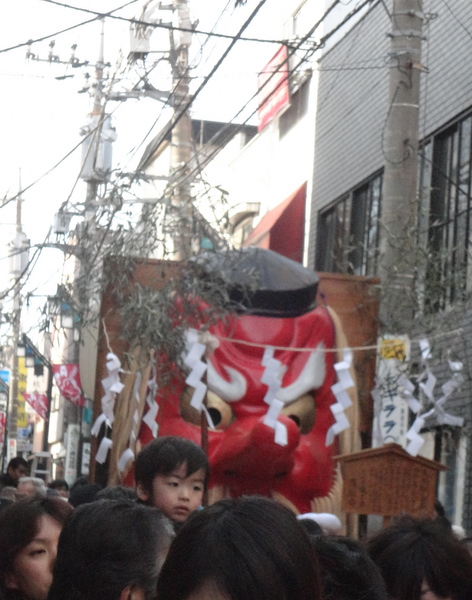
Every year, the weekend before Setsubun, there is a Tengu Festival in Shimokitazawa. When I first heard about this, I was delighted: fresh from my Tengu studies earlier this month, I was looking forward to seeing Tengu in real life.
I wasn't disappointed. The festival starts on Friday evening, when bars and restaurants around Shimokitazawa's Ichibangai get ready for a visit from Karasu Tengu. Not everywhere gets so blessed, but I was with Tengu fans and we had done our homework. Iida, possibly my new favourite Izakaya(it actually does desserts) looked like any other nice bar - until suddenly the doorway filled with a monster
We'd got there just in time for Karasu Tengu!
The town crier (left) wore special Tengu gloves, and he gave a pair to me
And that wasn't all. The following day, Karasu Tengu
was joined by Daitengu
and Daitengu effigies of all shapes and sizes
The streets were packed with Tengu lovers from all over Tokyo, some of whom carried this special parasol (a new lesson - Tengu don't like bright Japanese winter weather...they prefer to be in the mountains, under trees)
Drums were beaten in honour of Tengu
Fake beards were donned, for reasons beyond my limited imagination
Everybody had a good time performing 'mame-maki' (throwing, catching, and eating roasted soy beans at spirits to keep the bad ones away, and welcome the good ones)
I caught a bag of beans and kept them as a souvenir
...but my favourite Tengu was perhaps this poor soul sitting at the side of the street. Perhaps he'd been here since last year
If all festivals were as fun as this, no-one would ever do any work!
So when's the next festival, again?
Wednesday, 25 January 2012
First Snow
Winter is beautiful in Japan. In Kyoto last week, the sky was blue, and the sun was almost white
Even on overcast days, the bright grey light makes everything green or red look super-charged
But sadly, I think I'll have to go all the way to Kawabata's Snow Country (a long way and at least 15,000 yen for the train fare) if I want to see real snow...because Tokyo's first snow of the year this week was decidedly unimpressive. The view out of my window might as well have been a snap from a grey London motorway:
Like London, where snow is also never much more than sludgy sleet, it was just COLD, and wet. So when I decided to stay indoors and read about Japanese snow instead, things began to look up.
Yuki is the Japanese word for snow. Here is the Kanji
Yuki-onna is one of my favourite Yokai - a silent, beautiful, ruthless, sometimes violent, occasionally kind snow goddess.
She even has her own slightly dubious-looking trump card
One of the most famous Yuki Onna stories is from Lafcadio Hearn's brilliant collection Kwaidan, but there is more to her even than that. In old stories, she has killed men, borne human AND snow-monster children, haunted graveyards and melted away like an ice sculpture. And lots more.
Yuki also means 'revenge'. Combine them, and if you happen to be a comics genius like Kazuo Koike, you get the extremely addictive revenge manga Lady Snowblood

Here in Tokyo, all that's left of the real snow is a couple of sludgy patches around city drains. I think I'll stay indoors and leave nature writing to the professionals - this week at least, the words of Sei Shonagon and Basho are better than the real thing!
Even on overcast days, the bright grey light makes everything green or red look super-charged
But sadly, I think I'll have to go all the way to Kawabata's Snow Country (a long way and at least 15,000 yen for the train fare) if I want to see real snow...because Tokyo's first snow of the year this week was decidedly unimpressive. The view out of my window might as well have been a snap from a grey London motorway:
Like London, where snow is also never much more than sludgy sleet, it was just COLD, and wet. So when I decided to stay indoors and read about Japanese snow instead, things began to look up.
Yuki is the Japanese word for snow. Here is the Kanji
雪
Yuki-onna is one of my favourite Yokai - a silent, beautiful, ruthless, sometimes violent, occasionally kind snow goddess.
She even has her own slightly dubious-looking trump card
One of the most famous Yuki Onna stories is from Lafcadio Hearn's brilliant collection Kwaidan, but there is more to her even than that. In old stories, she has killed men, borne human AND snow-monster children, haunted graveyards and melted away like an ice sculpture. And lots more.
Yuki also means 'revenge'. Combine them, and if you happen to be a comics genius like Kazuo Koike, you get the extremely addictive revenge manga Lady Snowblood

Here in Tokyo, all that's left of the real snow is a couple of sludgy patches around city drains. I think I'll stay indoors and leave nature writing to the professionals - this week at least, the words of Sei Shonagon and Basho are better than the real thing!
Monday, 23 January 2012
Lunar Tokyo
I'm so often wrong about things in Tokyo that I might as well be on the Moon! Take New Year for example. I thought I'd 'done' it already: I went to a special 'old year exorcism' ceremony...
...ate traditional Toshi-Koshi 'Crossing of the Year' soba noodles for long life and good luck
and visited a whole lot of shrines and temples, including this
...and this
Hou Yi - an archer, a god - shoots down nine suns and saves the Earth from becoming an inferno. The sun god, furious, banishes Hou Yi and his wife Chang Er from heaven and turns them into mortals. Their only hope of regaining their immortality is if they each eat a Peach of eternal life - but they are only given one. Chang-Er, who hates earthly life more than Hou Yi, eats it and flies away to the moon, 'seeing' Hou Yi every night by shining down on him each night for the rest of his (mortal) life.
Well, almost every night. A few days later, from a flamenco bar in Golden Gai, Shinjuku
the moon started to disappear.
Then, just before the sky went totally black, the moon turned dark red, like the gruesome hopes of Lorca's lonely trickster moon in Blood Wedding
New year, new moon, old stories. Wonderful!
...ate traditional Toshi-Koshi 'Crossing of the Year' soba noodles for long life and good luck
and visited a whole lot of shrines and temples, including this
| Shoin Jinja, Setagaya, Toko |
| Daishoin Temple, Miyajima |
I thought I was done. But I was mistaken. New Year festivities are a long way from being over. Now, everyone is getting ready for the new year welcome fesival, Setsubun on 3rd February - you eat soup, wear masks and throw soy beans for good luck. But, before that, lots of people also celebrate Chinese Lunar new year. As the moon waxes over the two-week festival, people worship it like a goddess, made it into cakes (!) and use it as an excuse to spend more money in the shops than they do at all the other festivals combined (well that's what they told me on the telly yesterday, anyway).
I love thinking about the moon. One of the first stories I read in proper Japanese was the famous Chinese moon story, Hou Yi and Chang-e
Hou Yi - an archer, a god - shoots down nine suns and saves the Earth from becoming an inferno. The sun god, furious, banishes Hou Yi and his wife Chang Er from heaven and turns them into mortals. Their only hope of regaining their immortality is if they each eat a Peach of eternal life - but they are only given one. Chang-Er, who hates earthly life more than Hou Yi, eats it and flies away to the moon, 'seeing' Hou Yi every night by shining down on him each night for the rest of his (mortal) life.
Well, almost every night. A few days later, from a flamenco bar in Golden Gai, Shinjuku
the moon started to disappear.
Then, just before the sky went totally black, the moon turned dark red, like the gruesome hopes of Lorca's lonely trickster moon in Blood Wedding
New year, new moon, old stories. Wonderful!
Saturday, 21 January 2012
Miyajima Microtheatre
Theatres have a habit of popping up in strange places, but it was still a surprise to see a tiny proscenium in a forest half way up Miyajima's Mount Misen:
A forgotten puppet theatre? A fairy shrine?
Sadly, it was too cold to wait for the audience to gather, so I guess I will never know.
A forgotten puppet theatre? A fairy shrine?
Sadly, it was too cold to wait for the audience to gather, so I guess I will never know.
Subscribe to:
Posts (Atom)