Thursday, 6 October 2011

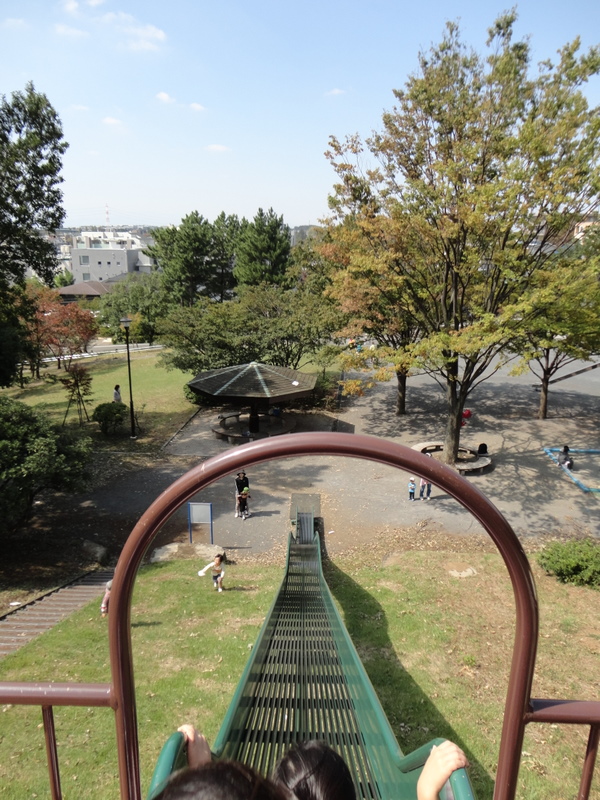
The Big Slide


I hadn't seen a slide this big for years, let alone slid down one. This is how it looked from the top, to me: god knows how enormous it looked to actual kids! It was really fast, too.

Coffee in Koenji

I'm not the biggest coffee fan in the world, which is probably a good thing in Tokyo. From what I've seen in the few weeks I've been here, the coffee you normally get is super sweet, actually milk in disguise, Starbucks mud, or so weak it's almost transparent.

But in the weekend, I was gloriously proved wrong right on my doorstep when I met a friend at Coffee Amp in Koenji, just one tube station away. Now I think I AM a coffee fan.

Time Out took a picture of a cup of Coffee Amp's bog standard cup:


The surprising thing for me - in Japan, I really shouldn't be surprised about it any more, but I am - was that the coffee really does actually look this beautiful when it arrives at your table in real life. And Coffee Amp is one of the only places I've seen here where you can buy coffee beans by weight, too. Hurrah!

Just as I was leaving, the owners very apologetically handed out a beautifully designed note explaining why their prices had to go up by a few yen (coffee beans just got a lot more expensive). I don't think I'd bother if I owned a coffee shop this good. But perhaps that's one of the reasons why I DON'T own one...

Coffee Amp. Perhaps it's the place that will finally get me a new addiction to add to sugar, salt, cigarettes, books, wine, and collecting pictures of strange monuments. The more the merrier, perhaps!

Wednesday, 5 October 2011

My First Kamishibai

An Englishwoman like me performing traditional Japanese picture storytelling - Kamishibai - in Japanese, but with an English story, is only a tiny bit less odd than triffids in tokyo. But that didn't stop me last week: I performed my very first Kamishibai to a group of 40 or 50 intent (read 'polite' rather than 'rapt') 4 year olds.

In Japanese, Jack and the Beanstalk is 'Jack to Mame no Ki'

It was one of those serendipitous accidents - I didn't mean to land myself infront of a big class with my hastily drawn pictures and super simplified storyline. But by some sort of linguistic mistake (I'm now practically famous for those), after I mentioned my work in progress in passing - 'Jack to Mame no Ki: Kamishibai' - appeared on a schedule. When something appears on a schedule here in Tokyo, it means that it is happening, unless you can give a good reason why not. I don't have the Japanese.

So, tingling with nerves and deading yet more abject humiliation, I went for it


A bit sheepishly at first


Then it just got too fun and I forgot to be sheepish


The highlight was definitely the bit near the beginning where Jack brings home a bean from the market instead of money and the shopping. Here is the offending bean


And here is Jack's mum when she sees it


What started off as a terrifying prospect ended up being immense fun. For me, at least. Who knows how much of my Japanese narration actually made sense? I've decided not to think about it - best just look forward to the next one.

I have a sudden urge to buy colouring pens.  

Tuesday, 4 October 2011

Tokyo Triffids

I never expected to find Triffids in Tokyo. But here is proof that they have now migrated from the England of John Wyndham's famous English novel and found a home in none other than in Kamakura, Tokyo's (utterly beautiful, exhaustingly full of shrines) answer to Kyoto.

At first, they looked just like they might always have been there. But it didn't take much to realise that these plants are most definitely tourists: nothing in a Japanese garden would ever look this messy


Then, more appeared...


Abunai! (lovely multi-purpose word, this - it means 'danger!', 'watch out', and also things like 'eek', 'oh crumbs' and other similar exclamations) I started to get nervous

but then I realised that, like all tourists in Japan, one of the first things you learn by example is how to form an orderly queue


So, at least I could only be devoured by one Triffid tourist at a time. Lucky me!

Fortunately though, with a little help from the Maneki Neko (Japanese cat good luck charm) I'd just patted on the head earlier that morning while spending far too much money on tourist tat...


...I narrowly escaped becoming lunch, and went off to have some myself.

If you go to Kamakura, stay away from the pond at the Hasedera Shrine. Don't say I didn't warn you.

Saturday, 1 October 2011

Wish! Fulfilment Part 4: Stories, songs and sneezes

This working week was immense fun, yet again, despite the appearance of my annual, inescapable, cold.

On Monday, I was a (coughing, sneezing, generally ugly and irritable) travelling minstrel of sorts - I was going to tell my stories and sing my songs, and people would sit back and enjoy the show...

Well, that was the illusion I was under until the bus dropped us off here after a two hour journey from Shinjuku Station


If it looks a little bit like purgatory, then I won't gainsay. My colleagues had got us LOST, in the middle of nowhere, as far as I could see. Of course there was still a McDonalds even here - there was even some talk of going to it.

BUT (relief!) at the moment we were beginning to walk off it that direction, we were rescued by an old man in a car, and taken somewhere much nicer


Where I began to attempt to tell stories in Japanese. Here is me trying my best


I guess I must have done something right (even if that thing was only 'look like a total idiot while talking very loudly): teachers kept on dragging me into classrooms to play encores. Yay! Delighted.

In the afternoon, back in the City near the bookshop district I mentioned the other week, I found myself giving a presentation on kids' storytelling. Slightly surreal, but I went with it, dressed in my best Hello Kitty attire


I then learned how to spin plates.

Back at Tamaplaza the next day, still coughing and sneezing, I was still in high demand. |Here's me trying my best wearing my ridiculous nursery apron (which I now am actually in love with!)

 really getting into it...


really REALLY getting into it


And the following day, on the other side of town, for a bigger audience, I did it again

And the next day


My favourite monster tshirt was probably the biggest hit, though

I learned three Japanese songs, assisted by the piano playing teacher


And then, I got to talk about London for a while.


Strangely enough, as interesting as red phone boxes are in my terrible Japanese language explanation, the kids were more interested in Harry Potter and Winnie the Pooh, and Peter Pan. Can't say I blame them. And no, I don't know them personally, more's the pity.

I slept very well on Friday night. Phew!

Something Old, Something New


I couldn't resist taking a photo of a girl in a super-traditional kimono (well it looked super traditional to me), checking an iPhone 4. In the middle of a super-new train station, leaning against the oldest looking staircase I've seen while I've been here.

Am I flaneur, voyeur, or just plain 'peeping Tom'?

Hmm.

Wednesday, 28 September 2011

Noh Feasting

It seems a long time since the Reading University Introduction to Noh workshop in the last two weeks of August. In a good way!

I am delighted that I am now a Toyko Noh Student. It went beyond my wildest dreams to hope that I'd be able to actually practice Noh - something so, well, Japanese (!) - here, in proper theatres. But, I am - twice a week, with all the proper kit, and learning new fascinating things about it every day.

I was taught the basics of how to use the kit at Reading, on a brand new portable Noh stage (just one of the many marvellous things Reading's new Theatre Studies building has inside it)


but it's a lot different here!


I also thought I'd never be able to afford to go and see much Noh, but thanks to the kindness of various people, I have now seen seven professional full length Noh plays, three Kyogen (fable-like funny plays used as interludes between the heavier, longer Noh), and a whole afternoon of 'greatest hits' bit and pieces. Here are some of the programmes


Soo lucky.


Professional Noh is quite a closed society - the actors are almost exclusively men, and, in Japan, exclusively from Japanese traditional acting families. There are five 'schools' of Noh acting - Komparu, Kanze, Kita, Hosho and Kongo. They all put on the same plays (there aren't THAT many to go around) but their techniques differ slightly. I'm told.

So far, I've been to see performanes by three different 'schools'. Most recently I was in Meguro, at the 'Kita' School theatre, where I saw three plays that aren't in my Penguin Noh Dramas translation, or particularly googlable. Luckily for me, my teacher gave me a bilingual edition of the second play, Hashitomi, to read along with during the show. I had to make do with synopses of the other two - Kogo (based on the Japanese traditional Tale of Heike, in which a beautiful lady koto player dances for a an emperor's messenger) and Kenjo, a no-holds barred spectacle of a piece, full of travel, ghosts and musical mastery.

Lucky for me, all three were relatively easy to follow - I can still only understand about one Japanese word in four. And that's when I'm feeling ambitious.

The first play I saw here in Tokyo was at the Kanze School Theatre in Shibuya - Kanze is apparently the most famous of all of the Noh Schools. They put on the very sombre Motomezuka (The Sought-for Grave) in which a woman who killed herself because she was loved by two men, gets lashed by demons in all different kinds of hells.


Stirring stuff. The flute music was so clear, sad and beautiful that I signed up for lessons straightaway.

A couple of days later I found myself at the Hosho School Noh Theatre, seeing another three plays: Iwafune (I have yet to find out ANYTHING about what it was about, but the demon at the end wore a huge red wig and that was enough for me to think it was at least interesting!), Tsunemasa, in which the ghost of a renowned lute player pines after the things he misses in the world of the living, and Momijigari, about an autumn foliage viewing party that takes a violent and supernatural turn.

I love the fact that you get to see lots of different plays in a Noh programme - it's normal for a programme to include at least three plays in one afternoon. The tickets look pretty complicated


but all becomes clear very quickly indeed.

I've already worn one pair of the new white Tabi I bought in Asakusa last week - the REALLY cheap pair. This Saturday, I get to wear the nicer pair to class. Lucky me!

More on Noh anon.