Trying to cram as much Japanese performance into my life before I go back to the UK is no easy task. Sometimes I approach it with dread
sometimes with out-and-out terror
But deal with it, I must. So, in May I saw about 15 hours of noh. Here's what happened:
At Umewaka nohgakudo, I saw my first noh completely performed by women. This almost NEVER happens in professional noh even though most of the main characters are women, or ghosts of them. In Semimaru, where a blind prince and his sister are reunited after years apart (in real life rather than in death or dream, for once), it was rather strange that the brother was actually smaller than the sister. But it didn't make any difference to the intensely moving moment when he recognises her voice, and she his face. They kneel before each other, and touch their fans together. It is so rare for characters to touch each other in noh plays (in most of the famous ones, every character is in his own world, within the waki character's mannered and symbolic dream) that when it does happen, it's like being struck by lightning or something. The power of the story didn't make the characters any easier- or indeed any less fun - to draw.
Then, a special performance at the National Noh Theatre, of Ama (The Diver) one of the oldest plays in the repertory and one of my favourites. I don't know enough about noh to tell the differences between the different noh performance guilds' practices, but I did like the special costumes enough to attempt to recreate them in pastel rather than biro for a change...
...and the sea dragon headdress wasn't bad either
Perhaps the best thing of all about the National Noh Theatre, though, is the seat-back surtitles (which you can set to English and/or modern Japanese). Despite the slightly odd Japanglish word order, being able to follow the spoken story reminded me, with a rush of delight how much the poetic language adds to noh's already utterly mesmerising feast of storytelling for eyes, ears and heart.
I was glad there were two plays I already knew in the marathon program at the Hosho school on 19th May because there was no English explanations for anything, at all! Compared to the performance of Rodaiko I saw at Kita nohgakudo a few months ago, Hosho's version felt generally quieter, sadder, less angry. y mind and my pencil wandered, to the Kyogen costumes
and, since I'm about to start learning noh drumming, the musicians:
I'd only seen the 'jumping lion dance' (shishimai) section from the end of Shakkyo before (it finished off the Takigi Noh performance at Meiji Jingu shrine last October. But at Hosho, I finally saw the whole play. Honestly, though, the red lion hair (which I rather anti-intuitively drew in black on the day, oops) is still the highlight for me
Finally, back 'home' to Kita's monthly performance. It wasn't only because I'd forgotten to bring anything but a yellow highlighter that I hardly drew at all. The warrior ghost play Michimori which began the programme, was so surprisingly moving that I couldn't take my eyes off it (which is why there is a proper print and not a scribble below)
The storyline wasn't unusual - a husband and a wife, both dead, lament the life and love they lost. But they do it standing beside each other in a boat, mirroring each others' slow, measured movements but never once being able to look at each other, while the music sounds a frenzy of grief, running wild in a way I imagined they might do themselves, if they could.
Asukagawa was another 'mother and child'/madwoman play like Hyakuman which I saw in April, with a beautiful scene where three rice planters sing about the perils of the Asuka River... but the demon play Nue (about a griffin-like creature who gives the Emperor terrible nightmares and is punished for it later) was the flashiest. Just like Shakkyo, the monster's dance at the end is dynamic and fast and exhilarating.
Phew! One month to go, lots more noh to see. Here goes!
Monday, 4 June 2012
Sunday, 27 May 2012
The Candymen of Harajuku
Last week, armed with a baking tin, a tiny bit of cocoa powder and lots of sweets, I made a Very Hungry Caterpillar birthday cake. It was delicious, but it wasn't beautiful enough for me.
Next, as Super Monkey practice, I made a very accurate and very banana-y Banana Cake:
Both were better than nothing (I won't say anything here about my attempt at flapjack, though) but I was missing a certain panache. I needed to learn from the professionals. So I set out to Harajuku, the style hub of Tokyo in search of the Candy Artisans.
And I found them.
I watched them, delighted, as they rolled out huge slabs of hot, pink sugar...
And I gasped as they brought out a solid sugar cylinder and rolled the slab around it like wrapping paper
Then, they rolled
and rolled
And kept on rolling until the whole lot was as thin as a pencil. But mesmerised as I was, it didn't take me long to realise that there was one Big Problem. In the middle of the candy roll, staring out at me, was a very unhappy face:
Before I could work out exactly who had been sacrificed to the Gods of sugar, I fled.
Beware. Don't eat too many sweets. Or the Candymen of Harajuku might get you.
Perhaps 'home made' is best, after all.
Thursday, 24 May 2012
Super Monkey, Asakusa
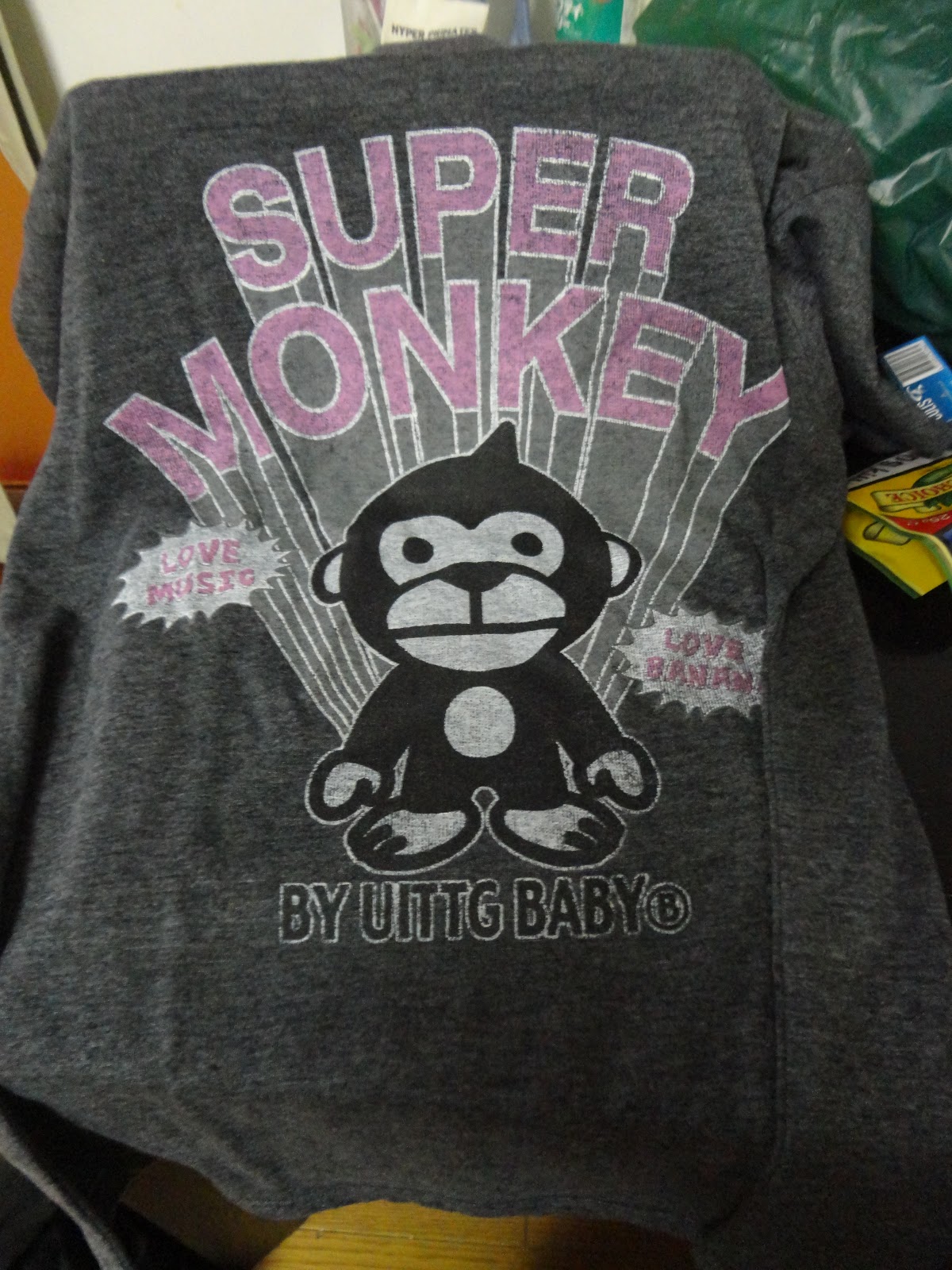
The instructions on the front of my newest Tokyo t-shirt (found in Asakusa when I was supposed to be shopping for tabi) suggested enthusiastically that I might have what it takes to be a Super Monkey:
| The speech bubbles say 'love music!' and 'love banana'! I love both. |
But when I turned it over, the obligations were a bit more onerous:
After ensuring my status by eating a banana as quickly as possible, I naturally wondered who else had passed the Asakusa 'Super Monkey' test. I looked around: at the big teams of people carrying portable shrines as part of Asakusa's biggest festival, the Sanja Matsuri
At the golden peacock on top of one of the shrines
And at the cartoon dog, who was waving at it
At the traditional musicians joyfully banging drums and playing unbelievably intricate flute melodies
And, at a group of oddly tall Daruma deep in conference about which of their followers were going to get their wishes granted today
They all clearly had Lives, but not one of them had any Bananas. I was the only Super Monkey in Asakusa.
They didn't seem to mind, though.
And neither did I!
Wednesday, 23 May 2012
Cute, Scary!?
I love things that are cute and scary at the same time (especially if they both appear on the same t-shirt)
But, when I went to get my fill of True 'cute' at the Rune Naito exhibition Roots of Kawaii...
...I was surprised. The show set was an enchanted house full of secret doors and inviting nooks, the kittens were out, the eyes were big, and the lollipops were even bigger. But, oddly, it really wasn't that cute. In fact, wandering around this quiet, brightly coloured world, I never thought 'aw, sweet!' once. Instead, I kept thinking of Alan Moore's porno masterpiece Lost Girls...
The comic is full of dolls, bright colours, and pretty ladies...but 'cute' is the last word I'd use to describe it. It was pretty - even enchanting, sometimes - but, like The Roots of Kawaii, also strangely unnerving. Still, and scary.
In Japanese, the word for 'cute' (kawaii) and the word for 'scary' (koaii) sound so similar that I often used to get them mixed up and kick myself for it. But that was before. Now I've been on Sanrio Puroland's 'Boat Ride of Joy'...
and found out that Hello Kitty is so big she could crush me with her bare hands...
- despite the adorable rounded pinkness of her house (where she invited me to pose for Hello style pics) -
... I don't think my semantic snafu was too far off the mark.
Which is absolutely fine with me!
But, when I went to get my fill of True 'cute' at the Rune Naito exhibition Roots of Kawaii...
...I was surprised. The show set was an enchanted house full of secret doors and inviting nooks, the kittens were out, the eyes were big, and the lollipops were even bigger. But, oddly, it really wasn't that cute. In fact, wandering around this quiet, brightly coloured world, I never thought 'aw, sweet!' once. Instead, I kept thinking of Alan Moore's porno masterpiece Lost Girls...
The comic is full of dolls, bright colours, and pretty ladies...but 'cute' is the last word I'd use to describe it. It was pretty - even enchanting, sometimes - but, like The Roots of Kawaii, also strangely unnerving. Still, and scary.
In Japanese, the word for 'cute' (kawaii) and the word for 'scary' (koaii) sound so similar that I often used to get them mixed up and kick myself for it. But that was before. Now I've been on Sanrio Puroland's 'Boat Ride of Joy'...
and found out that Hello Kitty is so big she could crush me with her bare hands...
- despite the adorable rounded pinkness of her house (where she invited me to pose for Hello style pics) -
| Hello Kitty's Daybed, with Kitty sweets |
| Hello Kitty's Dining Room, also with Sweets |
Which is absolutely fine with me!
Tuesday, 22 May 2012
The Perfect Scone Part 2: The Solution
I suppose I've been lucky: I've found pretty decent Japanese substitutes for most of the English junk food I miss. When I want a sausage sandwich, I eat a giant gyoza or a nikuman. When I want prawn cocktail crisps I'll go for a squid wafer cracker. Toffees? Morinaga's shio-butter caramels - the chocolate version just about soothes the terrible Rolo cravings I get every now and then.
But, try as I might, and though I did find some amazing cakes while I was trying (even the Starbucks here is good!), there was no replacement for the freshly baked English scone. I had to think of a plan.
The time I spent (or, wasted) staring into shops and dreaming of ovens
didn't change the fact that here in Tokyo they are as rare as indoor home swimming pools. So, I tried my luck with the tiny kanji-covered microwave in my tiny kitchen, that claimed it was also an oven. I was suspicious at first, but a few disasters later (easy to do if you mistake the Japanese for 'oven' for 'open', and the kanji for 'weight' for the kanji for 'time') voila! A working oven:
It took twice as long to heat up, and almost twice as long to bake anything (cue a few sunken stodgy first tries) - but that didn't stop me. Now I know that not only do they work, but you can put metal in them, and make properly crispy roast chicken (if you are lucky enough to find bird that hasn't been chopped into bite sized chunks anywhere in Tokyo). Hooray!
Having solved the oven problem, though, the next hurdle was the flour. I never knew quite how spoilt I was to have such easy access to feather-soft self raising flour in the UK. I got some interestingly disgusting results from using tempura flour (flour mixed with salt and soda) and okonomiyaki flour (flour mixed with salt and fish flakes) by mistake. But one day, right over on the other side of the supermarket, I got all excited when I found 'cake flour'! That was, until I took a scone out of the oven that more closely resembled a bullet than a cake. So, cake flour is plain flour with added cornflour, not baking powder. Right. I should have known that. Ok then. Plain flour, baking powder and bicarb it would have to be. My granny would have been proud. Tools below:
So, 'oven' set to 245c (not my usual fan-assisted 210), preheated for half an hour, and carrying a pile of what felt like all the white powders in the world, I was finally ready. My normal recipe had to change, but the routine was the same:
Sift flour and other random white powders (salt, sugar, baking powder, bicarb)
Add fat (normally I'd use all butter, but that makes the scones too heavy here for some reason. Best
combination I found was a mixture of half super-rich cheesy 'Hokkaido
butter' for flavour and half bizaarely grainy but light and almost completely flavour-free
Japanese margarine)
Rub in fat (as finely as possible, the flour here gets lumpy super easily)
Add liquid (plain milk is my preference at home, but here the soda needs extra help, so using thin yoghurt and a bit of water works best for me) and mix as quickly as possible with metal knife or spoon
Cut into small chunks with scissors (the nearest I was going to get to a cookie cutter in my student fleapit) and place on baking tray charred by several previous efforts...
Shove into the oven for 18 minutes (5 minutes longer than I'd ever leave them in at home, even though I cut them half the size here)
Then, pray 'taste good, taste good!'
Result!?
The plain ones weren't exactly 'perfect':
And neither, strictly speaking, were the raisin ones:
The cranberry ones were interesting if flawed, perhaps:
And the extremely yellow pumpkin and ginger ones were improvably 'interesting':
But for me, and everyone else who has tasted them here, they worked like a dream.
Saturday, 19 May 2012
Sumo and Song
To me, the best thing about this week's Grand Sumo Tournament in Ryogoku, Tokyo, wasn't the excitement of waiting for famous wrestlers to come down the passageway to the ring
or the wrestlers themselves arriving at the stage entrance outside
or the marvellous trials of strength, both physical
and mental
(and that's not even mentioning the sheer sensory overload of it all)
No, it wasn't any of these. To me, the best thing was the singing. A Sumo tournament was the last place I'd have expected to find the sort of singing that transports you back to Once Upon a Time world - but that's exactly what it did. One of the referees gets up at the start of each bout and sings the bout into being, anouncing the wrestlers' names and rankings as if they were words from some religious text. For me, the singing stole the show before the main event even started (despite the background noise and the fact that it was impossible to film from my seat miles away from the ring, though of course I attempted to anyway, result below)
Perhaps I shouldn't have been so surprised and amazed at this spectacle. The Sumo ring, with its roof and sacred inner space, is clearly modelled on Shinto shrines, and Sumo is itself perhaps even more about the ritual than the actual bouts. Later, I learned that Sumo originated as part of a religious harvest festival - that made sense. But oh, the haunting sound of the fan-carrying singer standing alone in the middle of the ring, voice ringing out across the crowd, was something else:
I might forget the wrestlers' names (actually, I already have), the rules of the game, and even where the stadium was. But what I will remember is the song.
or the wrestlers themselves arriving at the stage entrance outside
or the marvellous trials of strength, both physical
(and that's not even mentioning the sheer sensory overload of it all)
No, it wasn't any of these. To me, the best thing was the singing. A Sumo tournament was the last place I'd have expected to find the sort of singing that transports you back to Once Upon a Time world - but that's exactly what it did. One of the referees gets up at the start of each bout and sings the bout into being, anouncing the wrestlers' names and rankings as if they were words from some religious text. For me, the singing stole the show before the main event even started (despite the background noise and the fact that it was impossible to film from my seat miles away from the ring, though of course I attempted to anyway, result below)
Perhaps I shouldn't have been so surprised and amazed at this spectacle. The Sumo ring, with its roof and sacred inner space, is clearly modelled on Shinto shrines, and Sumo is itself perhaps even more about the ritual than the actual bouts. Later, I learned that Sumo originated as part of a religious harvest festival - that made sense. But oh, the haunting sound of the fan-carrying singer standing alone in the middle of the ring, voice ringing out across the crowd, was something else:
I might forget the wrestlers' names (actually, I already have), the rules of the game, and even where the stadium was. But what I will remember is the song.
Subscribe to:
Posts (Atom)