Saturday, 19 May 2012

The Perfect Scone Part 1: The Problem

I love baking (and eating) scones. So, when I came to Tokyo I was delighted that scones were everywhere! There were hundreds of varieties, from the jewelled super-scone


to the traditionally inspired (matcha flavoured)


to convenience-store seasonal varieties


home-made looking local bakery offerings


...and everything in between. Yum! I should have been in heaven. But I wasn't: instead, I felt like the country bumpkin in Aesop's The Town Mouse and Country Mouse: every single Japanese scone I tried was too rich: biscuity and cake-like and (to me) sickly. Where were the light, bread-like scones of Home? 

I dreamed about the sweet raisin variety:


The plain 'with jam and cream' variety:


Most of all, I dreamed of the heady, flour-and-sugar smell coming out of my oven on a Saturday morning. Mmm, Aah. But no...argh! Normally there wouldn't be a problem - I've baked thousands of scones in the UK, why not do the same in Tokyo? I'd already mixed up a batch in my mind - but then, the horrible truth hit me. Japanese homes don't have ovens. And, Japanese superarkets don't stock self-raising flour. So there was nowhere to put them, and nothing to make them with. The tools I had were a microwave and a bag of tempura flour, neither of which I'd ever baked with before. Eek!

So began a long journey of experiments, failures and tweaking before I finally bit into something worth the effort.

I don't usually bother with cupcakes, but if they were sausage shaped maybe I would!

Cupcake Project: Cupcakewurst: What would happen if, instead of stuffing a sausage casing with meat (or meat substitute), you stuffed it with cupcake batter?  I had to ...

Monday, 14 May 2012

Wish! Fulfilment: The Return (Part 1)

Last September I scuttled around nurseries and after school clubs all over Tokyo, telling stories in a mixture of awful Japanese, good English and a very strange brand of 'Laura-Japanglish', to kids between the ages of 2 and 7. Last month, I was delighted to be asked back to do it again.

Delighted, but nervous. Before, they'd given me 10 or 15 kids and nice short "wow, look, she's English, and she has a loud voice!" slots. This time, I had an hour to fill, and an audience of 30 or 40. My Japanese is a tiny bit better, but nowhere near good enough to hold an improvised conversation for an hour. Not without some serious cramming, anyway. Errk!

The brightly coloured objects (otherwise known as 'decoys') came out first:


...but before long, I had no choice but to start talking. With the help of a conveniently placed globe ('I am from here. We are here' etc) I introduced myself...


...and asked them to bear with me, because I'm a bit clumsy and I fall over a lot:


But when (too soon for me) that started to get old, it was time to get down to business.

Harapeko Aomushi made his first appearance since I got back to Tokyo in March. Thankfully, I can now actually read the thing in recognisable Japanese.


Then, I took a deep breath. After an excruciating moment of smiling in a rather desperate 'please stay - I really CAN speak Japanese!' way -


and a quick prayer to whichever Japanese deity happened to be listening that day...


and one or two magic spells of my own...


...out came The Three Litle Pigs - 'Sanbiki no Kobuta'. For anyone who doesn't already know the story, it's the one in which a rather angry Mother (Okaasan)


throws her three sons out of the house (or the field, depending on the version)...


where they find themselves all alone. Aw!


Before long, though, they get bored and start to think about building their own houses...


and then, they actually do it. Here, the first little pig is clearly having trouble putting the curtains up:


In the end, though, all three of them look at their new homes, pretty pleased with their first DIY efforts...


...that is, until a Big Bad Wolf, whose favourite food is fresh pork,


tiptoes upto the fields from the woods next door...
 

 ...and makes good use of his very large and powerful pair of lungs:


Two of the three houses got trashed. Lucky for the little pigs, though, the wolf hyperventilated trying to blow down the third.

When the Wolf (who, instead of getting roast pork, got his own tail roasted when he tried to climb down the third pig's chimney) was arrested for vandalism, his defence was 'well, it's their fault for being so inhospitable - I did knock!'


Dredging up my almost forgotten legal knowledge, I explained to him why that excuse wasn't going to wash:


So, the Wolf went to jail, paid his debt to society and became a Success Story. Transformed by the Prison Service, he became a vegetarian, developed an obsession with growing giant mutant peaches, and became the owner of an orchard next to a river in Old Japan...

But that's another story.

More soon!

Tezuka, T-shirts, Tokyo!

I really love musuem shops. In fact, often, the shop ends up being my favourite part of the exhibition.

Luckily that wasn't true of my visit to Setagaya's Literary Museum...


...where the exhibition of the work of manga superstar Osamu Tezuka was so interesting that not even my mind could wander very far:


 But I was even more delighted when the shop turned out to be just as good! Among other cute things, they sold delectable Astro Boy cake 'sets':


Best of all, though, they also sold me what might be the best t-shirt in the world, ever.

It looked great even in the packet


and even better out of it


Needless to say, I was delighted!


I already know that Tokyo is full of cool museums, and exhibitions, and cakes. But now that I've discovered that Tokyo is also full of amazing t-shirts, I feel a potentially dangerous new habit emerging.

Tee hee!

Tuesday, 1 May 2012

Cake Firsts!

I thought cake-only vending machines in Tokyo were like some sort of holy grail - everyone's heard of them, but no-one's actually seen one. But, at Waseda Station yesterday afternoon, all that changed.

My sheer delight even trumped the moment when, in a cafe on Wednesday night, this rather beautiful orange souffle dressed as a mini battleship, appeared before me and said, 'hi':


Perhaps it's just as well that I ate it before I finished my second glass of bubbly and got tempted to say 'hi' back. No-one ran away. And the two new friends I went out with are still speaking to me.

Phew!

Wednesday, 25 April 2012

Nohtes on Instruments

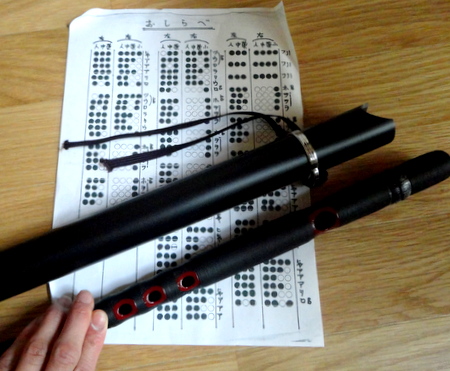
In honour of the fact that I can now get a nice sound out of my new noh flute


I decided to introduce my drawing hand to the noh 'orchestra'.

First, of course, the flute - the 'noh-kan'. The flute player's music opens every noh play, and signals most of the character entrances and special dances. The musician always sits (Japanese style, for the whole duration of the play - OW) at the back of stage left.


At the back of centre stage sit the Drummers. Biases aside, they are at least as important - if not more so - than the flautist. Left in the picture is the otsuzumi - a big drum that makes a clicking noise. Right is kotsuzumi - a smaller but strangely (for me) deeper-sounding instrument.


In noh, the voice is just as much of an instrument as the drum. A variety of strange-sounding calls ('yo', 'ho', 'hya') are actually written into the drummer's score, and followed by the dancer and the chorus. In practice - and sometimes, onstage, in emergencies, these instruments are 'played' with human voicemaking the relevant sounds.

Here's the noh band (minus singers) in neon --


Tuesday, 24 April 2012

My Noh Notebook: April 2012

At the Kita school 'normal noh' monthly performance on Sunday, I was, again, like last month, low on pencils. But I didn't think it would matter much because this time, I had homework - to listen carefully to the music and make notes on my own copy of the actual score. This is just one of several pages I have to know off by heart by the beginning of July, for a production of Atsumori in the US...


...so I had plenty to keep me busy. But even so, my fingers started to itch. I couldn't resist.  I got my pen out and...

Here are the grass-cutters, one of whom is actually the disguised ghost of the famously beautiful teenage warrior-musician Atsumori, who was killed by Genji warrior Kumagai on his way to fetch his flute during the battle of Ichi no Tani. The grass-cutters are talking to Kumagai himself, who has become a priest and renamed himself 'Rensho' in remorse after killing Atsumori:


 Everyone is amazed when, in the second half of the play, Atsumori's ghost actually appears, admits who he is, and in a series of dances, describes his death...


Then, Rensho wakes up. His conscience is lightened by his prayers for Atsumori's soul, and Atsumori's forgiveness.

This story, from Vol. 9 of The Tale of the Heike, is told in different ways all over the Japanese traditional arts. The Kabuki Ichi no Tani Futaba Gunki concentrates on Kumagai/Rensho's remorse and moral punishment - but the noh concentrates on the moment of clarity that enlightenment brings to both Kumagai/Rensho, and, from the afterlife, Atsumori. It is (rightly, in my opinion) one of the most famous plays in the noh repertory.

Hyakuman, the next play on the program, is a 'mad woman' noh play. Instead of featuring a separate ghost, the woman herself is haunted: this play is a lingering portrayal of a woman's grief at the loss of her son. The shape on the right was the enduring image of the play for me: a kimono sleeve raised up to the face in the stylised noh expression for inconsolable sadness


followed by a whirling dance and a tachimawari (walk around the stage) so poised and intense that it's easy to get swept away into the woman's desolation


Thankfully, these plays usually have happy endings: in Hyakuman, the woman is reunited with her son (who had been onstage all along sitting behind the priest). Phew!

Grief was the subject of the final play of the day, too. Tenko, the story of a miraculous drummer boy who was drowned in a river for disobeying the Chinese emperor's orders. Tenko's father is the main character in the first half: aged by grief, he is asked to play his son's drum and eventually does so. The sound of the drum plunges everyone into a dream world where Tenko's ghost appears and, delighted that people are praying for his soul, plays the drum once more.


Tenko is a strange play (for a start it's very unusual and oddly disorienting for the main character to change from an old man to a child's ghost half way through) and also on a grander scale than usual - international setting, large-ish cast. For this, I needed to (try to) get the whole stage in


But the play was long, and my hand got rather clumsy.

Perhaps this time I'll remember to bring not just pencils, but a much-needed eraser, too.